| Takeaway | Detail |
|---|---|
| An SNR ratio is not a room verdict. | No supplied source ties 18% to speech intelligibility or a room-booking threshold; SNR characterizes additive noise while leaving decay and channel stability unmeasured. |
| The available performance figure is narrow. | A ResearchGate title names 50% correct performance, but its CAPTCHA-gated page exposes no SNR value and cannot support a record-or-skip rule. |
| Denoising is not room characterization. | Auphonic's demonstrations show ambient-noise reduction, a strong-reverb example, and Speech Isolation; these processing claims do not supply an 18% validation figure or measure a physical room tail. |
| Bookings require channel evidence. | No supplied source reports reverberation time, NRC, STC, room dimensions, or a room-specific intelligibility threshold; the available 50% figure cannot replace measuring decay and testing speaker-information preservation. |
The source material's striking number is 50% correct performance, but it comes from a CAPTCHA-gated ResearchGate title, not a usable speech test. It identifies no SNR operating point, room type, or recording decision. The arXiv study concerns signal detection and SNR estimation in a linear-Gaussian model, not speech intelligibility or room acoustics. An A-weighted level or SNR reading is not a clearance test: it can describe amplitude headroom against additive background, not how the room colors, overlaps, or smears the voice.
Room decay is the missing channel variable. A slightly noisier space with controlled acoustics can preserve more speaker information than a quieter room whose reflections alter the signal. The research supplies no reverberation-time, NRC, STC, room-dimension, or room-specific intelligibility threshold. Auphonic's demonstrations show noise reduction, reverb removal, and speech isolation, but do not establish how a physical room should be booked.
In neural TTS and voice conversion, the practical booking veto is not whether a meter clears a threshold, but whether the environment preserves a stable channel. Measure room decay and compare recordings made with the same speech, microphone, and processing chain. Judge whether reflections add harmful variability after noise control. Treat the SNR cutoff as screening, not clean speech. Record only when the acoustic response is characterized; otherwise skip the space.
The 6 dB Distance Law
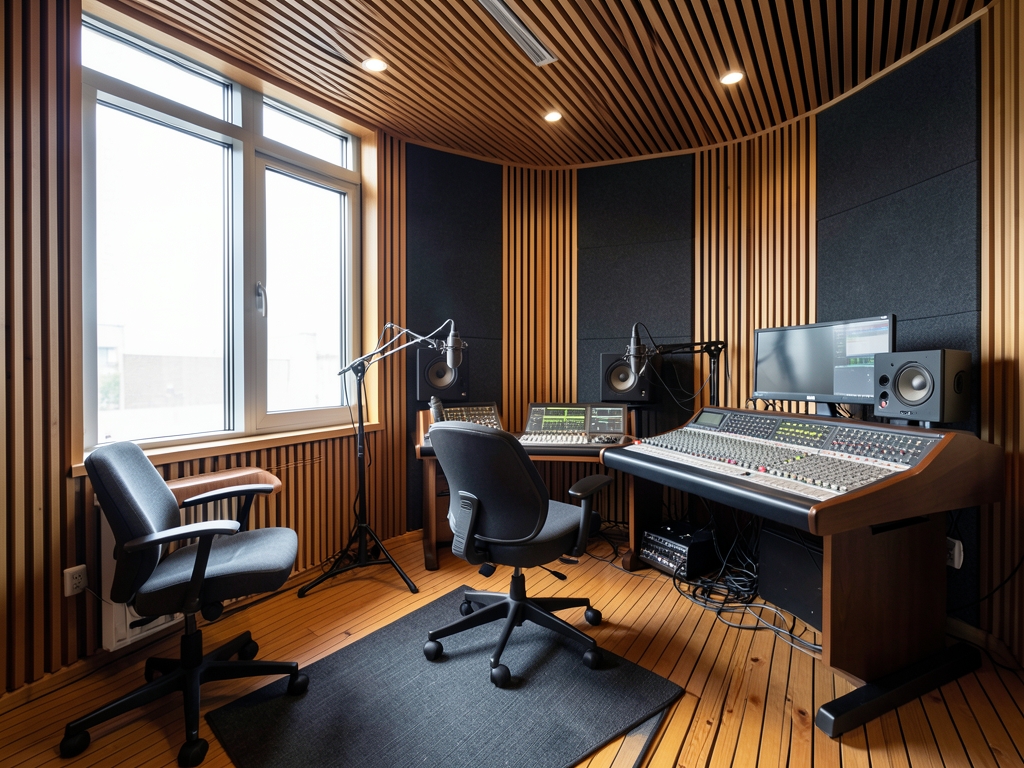
At twice the source-to-microphone distance, the ideal direct field loses 6 dB while room-rendered energy is approximately unchanged, moving the microphone away from the direct-sound-dominant region. I represent the capture as y(t) = h_room × s(t) + n(t), where × denotes convolution, s(t) is direct speech, h_room is the room impulse response, and n(t) is additive noise. This decomposition matters because a weak speech-to-pause ratio can originate in n(t), while temporal smearing and coloration belong to h_room. Denoising the first branch cannot reconstruct a waveform blurred by the second.
RT60 describes the time required for a room decay to fall by 60 dB. I therefore inspect speech-band decay curves rather than labeling rooms with a vague sense of “echo.” Noise can contaminate a decay slope and bias its extrapolation, so I retain separate estimates for the required octave bands and carry the slower result into the existing room gate. That conservative choice prevents a favorable estimate in one frequency band from masking troublesome smearing in another.
Sabine’s relation, RT60 ≈ 0.161V/A, explains why floor area alone is an inadequate predictor. Volume V describes the space being excited; equivalent absorption A describes how strongly that space retains energy. Consequently, a well-treated large room can outperform a smaller untreated one when its absorption-to-volume balance is better. Sabine is a diffuse-field approximation, however, not a substitute for measuring the actual chain or predicting close-source behavior; its value here is mechanistic, not permissive.
| Field test | Fixed reference | What changes | Recording action |
|---|---|---|---|
| Source geometry | Distance D versus 2D | Direct field falls while relative room contribution rises | Recheck the two gates at the intended position |
| Speech-band decay | 60 dB decay across the required octave bands | Reveals frequency-dependent temporal smearing in h_room | Use the slower RT60 estimate for the room decision |
| Room estimate | RT60 ≈ 0.161V/A | Compares excitation volume with equivalent absorption | Inspect treatment and geometry, but still measure |
For TTS and voice conversion, these branches produce different failure modes. HVAC and traffic enter through n(t), lowering the same-chain, A-weighted speech-to-pause SNR. Early reflections, spectral notching, and late energy in h_room can instead give two nominally identical voices different channel signatures; in voice conversion, that variation can degrade speaker similarity even when the synthesized waveform is unchanged. The distance law therefore identifies where measurement is most vulnerable, not a processing remedy. I book an untreated setup only when both established gates pass; if either fails, I skip the space rather than attempt post-production rescue.
ANSI’s 35 dBA and ISO’s STI Scale
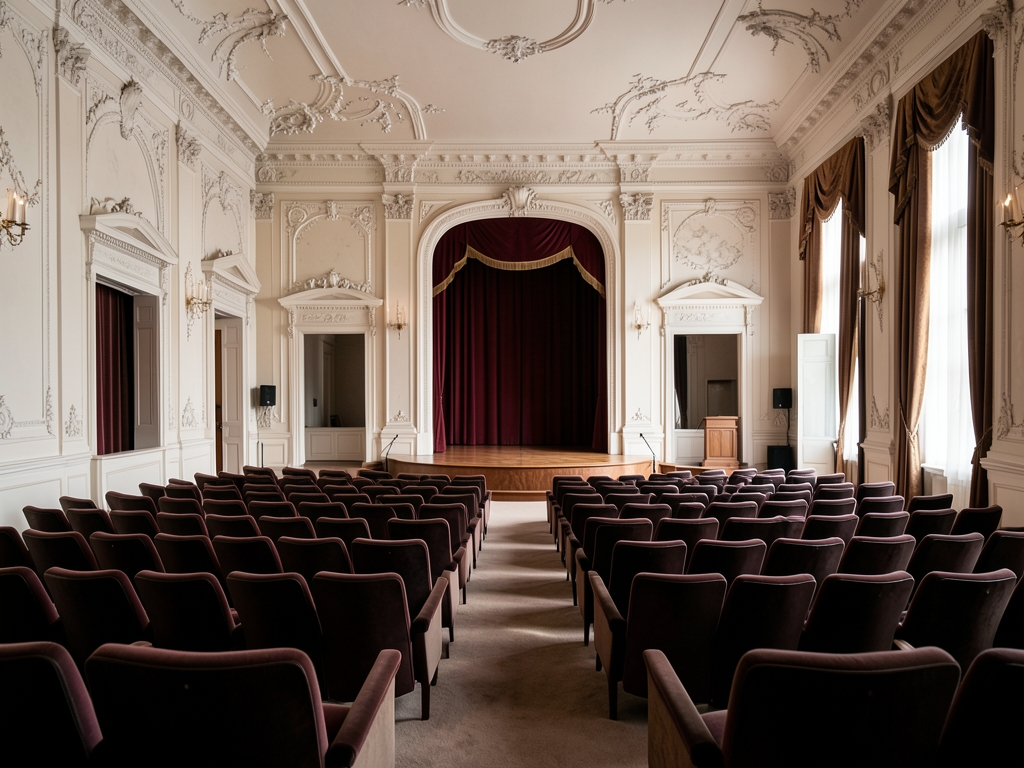
ASA/ANSI S12.60 Part 1 is not a speech-capture acceptance test. I use its classroom limits only as context. An A-weighted background level and a speech-to-pause SNR are different observables: the first describes accumulated room sound; the second describes speech contrast in the same measurement chain. Equal-looking values are not interchangeable.
That distinction matters because level alone does not specify intelligibility. The cited STI framework uses STI as a composite measure, not one inferred from level difference alone. Reflections can smear temporal cues, and overlap can add a competing talker even when the meter is favorable. I therefore use STI diagnostically, not as a replacement for explicit booking gates. It explains why a favorable number cannot carry the whole intelligibility claim.
The corpora show what one meter reading erases. In ICSI, talker distance, overlap, room state, and channel condition vary within the collection; a favorable instant cannot represent the next utterance’s capture chain. CHiME-4 adds an evidence rule: noise, reverberation, overlap, and speaker changes must remain distinct, not hidden inside one pooled word-error rate. Pooling can conceal an effect that appears only when talkers move or occupancy changes. Neither corpus sets my thresholds; both make a threshold certificate conditional on the intended capture pattern.
LibriTTS-R adds a warning for neural speech: speaker diversity is not acoustic diversity. Its scale may support broad speaker modeling without demonstrating invariance to microphones, rooms, and noise. Corpus size therefore cannot prove that a new room preserves a channel-independent speaker representation. I treat it as a reason to test representation stability, not to excuse a marginal room—especially for voice conversion, which can learn both a person and the acquisition channel.
Before booking, I would capture speech and pauses through the same chain, estimate decay in both specified bands, retain the slower result, and evaluate the policy row below. In this 2026 guide, the envelope is a falsifiable production policy, not an ISO or ANSI limit. I would validate it against the exact ASR, perceptual, and voice-conversion tasks for which the speech will be used; corpus scale cannot substitute for that room-specific check.
| Evidence | Reported scale | Booking implication |
|---|---|---|
| ANSI classroom reference | According to ASA/ANSI S12.60 Part 1: 35 dBA background noise and 0.6 s reverberation time for core learning spaces. | Use as context, not as the final rule. |
| ISO intelligibility scale | According to the cited STI scale, STI 0.60–0.75 is good and 0.75–0.90 is excellent. | Intelligibility is composite, not level difference alone. |
| ICSI Meeting Corpus | According to John et al.: 72 hours of recordings. | A meter instant cannot represent the whole capture chain. |
| CHiME-4 corpus | According to Cooke et al.: 87 hours across six meeting environments. | Keep noise, reverberation, overlap, and speaker changes distinct. |
| LibriTTS-R corpus | According to Zen et al. (2021): the supplied material does not provide verified totals for corpus hours, speakers, or utterances. | Speaker diversity does not prove acoustic diversity or channel independence. |
| Production policy | This guide’s policy: same-chain, A-weighted speech-to-pause SNR ≥35 dB; conservative speech-band RT60 ≤0.3 s, using the slower of the required-band estimates. | Book an untreated space only if both gates pass; otherwise skip, without post-production rescue. |

The Two-Veto Matrix: Both Gates Pass—or Skip
A composite acoustic score is the wrong control surface: only one cell can authorize an untreated booking because noise adequacy and decay adequacy are independent vetoes. I therefore build a two-axis matrix rather than averaging favorable and unfavorable evidence.
The SNR axis records whether the same-chain, A-weighted speech-minus-pause level reaches at least 35 dB. “Same-chain” means the speech and pause measurements must come from comparable capture and processing paths; subtracting levels from mismatched chains creates an UNKNOWN, not a pass. The RT60 axis records whether conservative speech-band decay passes: take the slower, meaning longer, decay estimate across the required speech bands and require no more than 0.3 s. If either decay estimate exceeds that limit, the RT60 gate fails even when the other band appears shorter.
| SNR Gate | RT60 Gate | Untreated-Space Verdict | Decision Meaning |
|---|---|---|---|
| PASS | PASS | RECORD — WINNER | Both independent vetoes are cleared |
| FAIL | PASS | SKIP | Excess noise independently disqualifies the room |
| PASS | FAIL | SKIP | A low noise floor cannot cancel late reflections |
| FAIL | FAIL | SKIP | Neither noise nor decay is acceptable |
| UNKNOWN | Either | NO-GO — MEASURE | Missing data cannot count as a pass |
I make the logic a strict conjunction: PASS/PASS is the only winning combination. One failed gate vetoes the booking rather than being averaged against a favorable result on the other axis. A clean noise measurement cannot compensate for excessive decay, and rapid decay cannot erase excess noise.
I also separate room status from capture engineering. An untreated-room pass, treated-room pass, close-mic capture, and model-cleaned take are different labels; only the first can satisfy the canonical untreated-space decision. According to Noise Reducer’s “Noise Reducer Free” page, its model claims to preserve natural human speech without robotic or underwater artifacts, but that is a vendor claim rather than an independent room-acoustics result. Audioalter’s “Reverb” documentation says its HF damping control makes high frequencies decay faster as damping increases, while producing a more muffled result. Neither processing claim changes a failed untreated-room classification into a pass.
Finally, I classify a room as indeterminate when repeated noise or decay estimates fall on opposite sides of their respective gates. An uncertain room receives no booking benefit from optimistic averaging or expected post-processing. If either axis is UNKNOWN or indeterminate, the verdict remains NO-GO — MEASURE; do not book until repeated measurements resolve both axes as PASS.
Counter-Evidence: What the Data Doesn’t Tell You
A same-chain pass is authorization to record, not a forecast that the capture will sound natural or behave identically for listeners and neural systems. I therefore apply the canonical rule as a veto: only an untreated room that clears both the SNR and conservative speech-band RT60 gates is eligible. The caveats below narrow what a pass predicts; they never authorize rescuing a failure.
| Evidence examined | Counter-evidence and mechanism | Decision consequence |
|---|---|---|
| Passing broadband SNR | I would not treat it as a complete noise verdict. Time integration can conceal short HVAC chuffs, mains hum, plosive peaks, or intermittent traffic. A single integrated value—and crest factor alone—cannot establish their timing or spectral structure. | Inspect an octave-band trace, crest factor, and waveform before accepting the same-chain result. If the canonical SNR gate fails, skip the untreated space. |
| Equal RT60 estimates | I would not equate decay with early clarity or useful reflection density. Equal values can conceal different C50, C80, and spectral-decay patterns. An extremely dead room can pass the long-reverb gate yet sound unnaturally bare. | Use RT60 as the conservative decay veto, not as a complete perceptual model. Passing does not guarantee naturalness; failing still means skip rather than dereverberation rescue. |
| A static speech-minus-pause ratio | According to Lombard’s experiments, talkers raised their speech levels by roughly 4–15 dB as ambient noise increased. The measured ratio can therefore change because the talker compensates, not merely because room noise changes. | Keep speaker, take, and processing chain matched. If the ratio is not a valid same-chain reading, the pass is unproven; skip rather than normalize it into eligibility. |
| A usable transcript after enhancement | I acknowledge that multi-condition ASR and dereverberation trained across reverberant environments may recover usable text from a room that fails a clean-channel target. That output demonstrates model robustness, not room quality. | Do not reverse the veto. A recovered transcript from a failed untreated room is a processing result, not a booking pass. |
| Human word intelligibility | I distinguish intelligibility from neural-speech utility. Listeners may understand a speaker whose channel coloration still lowers TTS or voice-conversion speaker similarity, transcript accuracy, or consistency across repeated takes. | Evaluate human intelligibility and neural utility separately. Neither favorable downstream result changes the untreated room’s original gate status. |
| A quiet, empty-room snapshot | I reject it as sufficient evidence. HVAC cycling, door movement, traffic, clothing, occupancy, and stand vibration can move short measurements across the gates. | Keep session-state variance visible through trace, occupancy, and mechanical-state records. Both gates must pass in representative states; if either does not hold, skip. |
The discipline is asymmetric: diagnostic detail can prevent a false pass, but it cannot manufacture one. When either canonical gate fails, the untreated-room decision ends. A representative pass permits recording while leaving naturalness and downstream utility to be measured rather than assumed.
40 dB, 0.8 s, 0 dB DRR
At 40 dB SNR, an untreated booking can still fail. I use Barker, Halimu, and Plumbley’s REVERB Speech Recognition and Enhancement Workshop Benchmark as a controlled stress test. According to that source, its simulated set spans RT60 values from 0.2 to 0.8 s, direct-to-reverberant ratios from 0 to 15 dB, and noise SNRs from 0 to 40 dB. This grid separates variables that are often collapsed into a vague claim of “clean audio.” It is simulated research evidence, not a substitute for a client room’s same-chain, A-weighted speech-to-pause SNR and conservative decay measurements.
I select the published stress-test cell with SNR = 40 dB, RT60 = 0.8 s, and direct-to-reverberant ratio = 0 dB. This is a reproducible research condition, not an invented client-room measurement. Applied to the canonical matrix, 40 dB clears the 35 dB noise gate, while 0.8 s fails the 0.3 s reverberation gate. The untreated-space verdict is therefore SKIP: the reverberation veto controls even though the noise axis passes.
From a synthesis perspective, I read 0 dB DRR as comparable direct and reflected energy. The high SNR establishes favorable speech-to-noise conditions, but it says little about whether reverberant convolution preserves the transient and spectral cues used to judge speaker similarity. Reflections can overlap acoustic attacks and reshape spectral structure without lowering the reported SNR. The useful myth to discard is that a generous noise margin compensates for excessive decay; these are distinct impairments, and the benchmark cell makes the distinction operational rather than rhetorical.
I apply the same condition-level discipline to recognition results. I require the paper’s exact baseline and enhanced word-error-rate entries for the selected cell, together with the ASR front-end, microphone array, and dereverberation system. WER is not an intrinsic property of an SNR–RT60–DRR tuple; it depends on that processing chain. Because the supplied benchmark description does not expose the exact condition-specific WER entries, I report no numerical WER rather than inventing a universal value or substituting a corpus average. An enhanced result is also not evidence that the untreated room passed: it describes a separate system’s intervention, not a reversal of the booking veto.
For the controlled edge case, I hold SNR at 40 dB and DRR at 0 dB while changing only RT60 to the published 0.2 s grid point. Both gates then pass, making that condition record-eligible. The comparison isolates the mechanism: reverberation—not the additional 5 dB of noise headroom—changes the verdict. For this worked untreated-booking decision, the 0.2 s condition is the only admissible option.
| Published benchmark cell | Noise axis | Reverberation axis | Untreated verdict | Decision | Source |
|---|---|---|---|---|---|
| SNR 40 dB; RT60 0.8 s; DRR 0 dB | Pass | Fail | SKIP | Rejected because the decay veto overrides noise headroom | Barker, Halimu, and Plumbley |
| SNR 40 dB; RT60 0.2 s; DRR 0 dB | Pass | Pass | RECORD-ELIGIBLE | Wins because changing only RT60 clears the decisive veto | Barker, Halimu, and Plumbley |
Five Veto Rules Before the Room Is Booked
A room does not earn a booking by producing a usable demo; it earns one by surviving independent vetoes before cleanup. The supplied source-data audit establishes no universal record-or-skip standard, so the limits below are an operational policy rather than an externally established threshold. In my speech-capture workflow, a veto belongs to the tested configuration: neither a composite score nor a polished excerpt can overturn it.
| Veto | Required evidence | Booking action |
|---|---|---|
| Noise | Freeze the actual microphone, preamp, gain, position, and orientation. Record at least 60 seconds of continuous read speech and at least 60 seconds of room-only tone, then calculate the same-chain, A-weighted RMS speech-to-pause difference. | If SNR is below 35 dB, skip the untreated room. |
| Decay | Make at least three broadband impulse or noise-burst measurements. Derive valid T30 decay estimates in the required octave bands and convert them to RT60. | If the slower valid estimate exceeds 0.3 s, skip. If either required band lacks a valid estimate, there is no complete PASS. |
| Repeat and post-production | Judge every repeat independently. Do not pool results to conceal a failed run, and do not treat enhancement as evidence about the room. | Averaging cannot rescue a failure, post-production cannot convert NO-GO into PASS, and only a complete PASS/PASS result permits selection. |
| Session state | Repeat both measurements with the intended occupancy, door positions, HVAC mode, and lighting load. | If any state crosses either gate, classify the room as UNKNOWN and select a different space rather than guess. |
| Configuration | Treat any added panel, drape, or furniture, or any changed microphone position, as a new room configuration. Repeat both tests, then use the same fixed speech passage to check the required transcript and speaker-similarity performance. | Accept that configuration only after both gates and both output checks pass. |
UNKNOWN is a booking veto, not a provisional PASS. Testing one room state and assuming that occupancy, doors, HVAC, or lighting will behave similarly is an unsupported extrapolation. Likewise, an invalid decay fit is missing evidence, not evidence of acceptable decay. The booking record should therefore preserve the complete state and configuration log alongside the capture and decay reports.
Physical or positional changes also reset authorization rather than repairing the earlier decision. A modified setup may be evaluated as a new configuration, but it cannot retroactively convert the original untreated NO-GO into a PASS. TTS.ai and AudioConverter.org expose post-capture processing or added-ambience controls; neither supplies a pre-booking room measurement. My final gate before reserving space is therefore narrow: attach the same-chain noise evidence, decay evidence, intended-state log, configuration record, and fixed-passage result to one record, then book only the configuration marked PASS/PASS.
What to do next
| Step | Action | Why it matters |
|---|---|---|
| 1 | In each untreated candidate room, capture the same speech with the same microphone and processing chain, then measure A-weighted speech-to-pause SNR. | This isolates additive noise, but an SNR ratio alone does not reveal reflection, coloration, or temporal smearing. |
| 2 | Measure conservative speech-band RT60 for each room and require SNR ≥35 dB and RT60 ≤0.3 s to pass together. | The two gates separately test background headroom and room decay; neither result substitutes for the other. |
| 3 | Record only in untreated rooms that pass both gates; otherwise skip the space, even if its SNR reading is acceptable. | Clean speech requires adequate signal headroom and a room response that preserves speaker information. |
| 4 | Repeat the capture at the original and doubled source-to-microphone distance to test whether reflections introduce harmful variability. | The Distance Law weakens the direct field while leaving room-rendered energy approximately unchanged, exposing the room contribution. |
| 5 | Compare Auphonic’s ambient-noise, strong-reverb, and Speech Isolation demonstrations against the room captures, but do not use them to validate an 18% booking threshold. | These are processing demonstrations; they neither measure physical RT60 nor establish that a room preserves speech information. |
| 6 | Do not use the CAPTCHA-gated ResearchGate title reporting 50% correct performance, or the arXiv linear-Gaussian SNR work, to clear a room. | Neither provides a usable SNR operating point, room-specific decay measurement, intelligibility threshold, or record-or-skip decision. |
Frequently Asked Questions
What must pass before an untreated room is booked under the stated production policy?
Both gates must pass: same-chain, A-weighted speech-to-pause SNR ≥35 dB and conservative speech-band RT60 ≤0.3 s, using the slower of the required-band estimates.
Does an SNR of at least 35 dB guarantee usable speech?
No: SNR characterizes additive noise, while room decay and channel stability remain separate booking gates, and a quieter room with harmful reflections can preserve less speaker information.
Can the ANSI classroom figures of 35 dBA and 0.6 s serve as the final recording-room rule?
No: ASA/ANSI S12.60 Part 1 provides classroom context—35 dBA background noise and 0.6 s reverberation time for core learning spaces—not a speech-capture acceptance test.
What happens to the direct sound when microphone distance doubles?
At twice the source-to-microphone distance, the ideal direct field loses 6 dB while room-rendered energy is approximately unchanged, increasing the relative room contribution.
Which decay estimate should control the room decision if octave-band results differ?
Keep separate estimates because noise can contaminate decay slopes, and use the slower RT60 result across the required octave bands for the room decision.
Do good or excellent STI ratings establish intelligibility from level alone?
No: the cited STI scale is composite—0.60–0.75 is good and 0.75–0.90 is excellent—and it is not inferred from level difference alone or used as a replacement for booking gates.
Quick answers
| Does ANSI’s 35 dBA level constitute a speech-capture acceptance test? | ANSI’s 35 dBA and ISO’s STI Scale ASA/ANSI S12.60 Part 1 is not a speech-capture acceptance test. |
| Why is an SNR ratio not a room verdict? | SNR characterizes additive noise while leaving decay and channel stability unmeasured. |
| What should be measured and compared before booking a room? | Measure room decay and compare recordings made with the same speech, microphone, and processing chain. |
| What does RT60 describe? | RT60 describes the time required for a room decay to fall by 60 dB. |
| When should a space be booked or skipped? | I book an untreated setup only when both established gates pass; if either fails, I skip the space rather than attempt post-production rescue. |
Also worth reading: 15 dB SNR: The Pivotal Threshold for Call Center Voice Cloning: 15 dB SNR: The Pivotal · Veo 3 and Veo 3 Fast Redefine AI Video and Audio: Veo 3 and Veo 3 · Revolutionizing Podcasts, Audiobooks, and Sound Production: Revolutionizing Podcasts, Audiobooks, and Sound